
/ From: / Review:72
Driven by the interconnection demands of AI computing clusters and hyperscale data centers, traditional front-panel pluggable transceivers face fundamental bottlenecks: high electrical loss over long PCB traces, heavy DSP power consumption, and limited front-panel port density. NPO (Near-Package Optics) and CPO (Co-Packaged Optics) are two leading optical interconnect architectures. Both shorten the high-speed electrical path between ASIC and optical engine to cut signal attenuation and reduce DSP power overhead. However, they differ fundamentally in integration structure, serviceability, manufacturing difficulty and market positioning: NPO is a practical interim solution compatible with existing O&M systems; CPO is the long-term ultimate architecture targeting extreme bandwidth density and power efficiency.
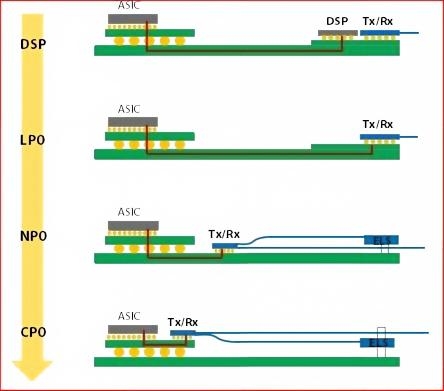
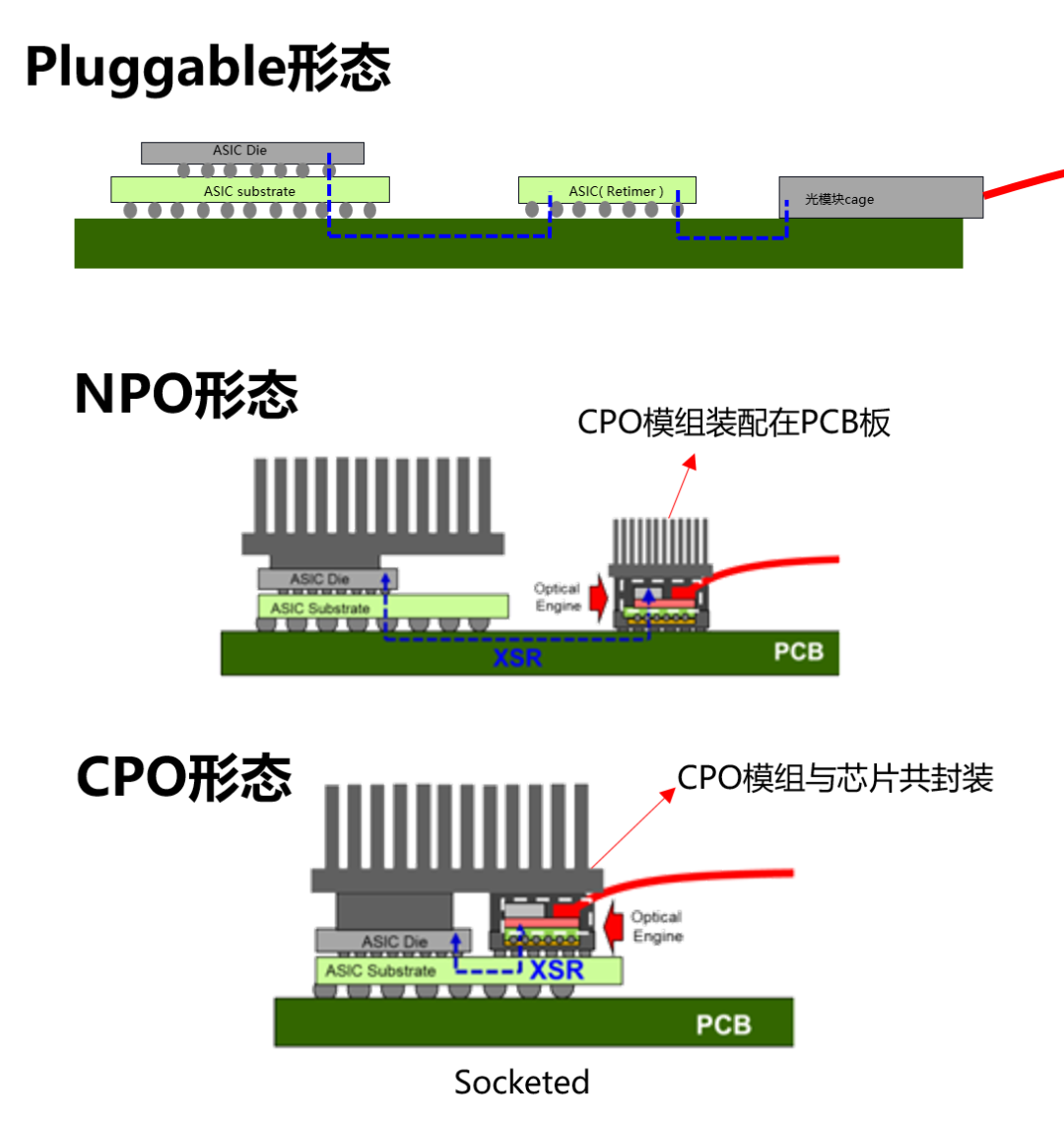
Diagram Description:
· Traditional DSP pluggable: ASIC → long PCB trace → front-panel module (with DSP inside)
· NPO: ASIC → short PCB trace (cm-level) → board-mounted, replaceable optical engine
· CPO: ASIC and optical engine co-integrated on the same substrate; electrical path is only mm-level
1. Definition & Working Principle
CPO – Co-Packaged Optics
CPO adopts 2.5D / 3D advanced packaging technology. The optical engine (silicon photonic PIC, Tx/Rx array) and switch ASIC / GPU die are packaged together on a common interposer or substrate. The high-speed electrical path is reduced to millimeter scale, almost eliminating signal loss from copper PCB traces. Most CPO designs remove power-hungry DSP or retimers.
The optical engine becomes part of the ASIC package instead of an independent module. Most CPO systems use remote laser modules (RLM / ELS) to supply continuous-wave light for multiple optical engines.
Advantages: best signal integrity, highest bandwidth density, lowest power per bit, breaking the front-panel I/O density limit of switches.
Challenges: optics and electronics are tightly bonded; failed optical engines usually cannot be hot-swapped separately. Thermal crosstalk between high-power ASIC and photonics is severe. Combined packaging yield of PIC and EIC is challenging, and the supply chain ecosystem is still under development.
NPO – Near-Package Optics
In NPO, the optical engine is mounted on the main PCB right next to the ASIC package, but not co-packaged on the same substrate. The high-speed electrical trace is shortened to 2–5 cm (centimeter scale). Electrical loss is greatly reduced, and most NPO implementations eliminate DSP as well.
The most distinctive feature: the optical engine is a standalone, detachable component that can be replaced on site. It fits the existing data center maintenance workflow. NPO builds on mature silicon photonics and optical assembly technology; it does not require disruptive advanced packaging lines. ASIC and optical engine can be designed and sourced separately from different vendors, supporting an open multi-supplier ecosystem and faster commercialization.
Positioning: widely recognized as the preferred mid-term transition architecture, balancing performance gain, cost and serviceability.
2. Comparison Table
Items
CPO (Co-Packaged Optics)
NPO (Near-Package Optics)
Electrical trace length
Millimeter scale (<5 mm)
Centimeter scale (2~5 cm)
Integration
ASIC and optical engine on shared substrate
Optical engine adjacent to ASIC, separate substrate
Serviceability
Poor; optical engine failure usually requires full package replacement
Excellent; optical engine can be swapped individually
DSP requirement
Mostly DSP-free / no retimer
Mostly DSP-free / no retimer
Power consumption
Lowest, 50%~70% saving vs traditional pluggables
Medium-low, 30%~50% saving vs traditional pluggables
Bandwidth density
Highest, removes front-panel density limit
High, better than LPO & conventional pluggables
Thermal risk
High; strong thermal coupling between ASIC and photonics
Low; thermal decoupled, mature thermal design
Manufacturing barrier
Extremely high, relies on 2.5D/3D co-packaging yield
Moderate, based on mature silicon photonics & SMT
Ecosystem
Relatively closed; standardization under OCI MSA
Open, multi-vendor compatible, easier mass production
Commercial status
Pilot deployment in top-tier supercomputing clusters
Sampling & verification, priority route for near-term rollout
Typical use case
Large-scale AI training clusters,
ultra-high-density switch fabrics,
power-critical nodes
Medium & large compute clusters, intra-rack / inter-rack links, balanced O&M & cost
3. Pros & Cons Summary
CPO
✅ Pros: Ultra-low power, maximum bandwidth density, minimal signal loss and latency; the long-term endgame for optical interconnect.
❌ Cons: High repair cost, complex thermal design, low packaging yield, high upfront investment, incomplete standards.
NPO
✅ Pros: Solid performance gain, field-repairable, mature and controllable process, lower deployment risk, open supply chain.
❌ Cons: Power and density ceiling is inferior to CPO; minor residual loss from short PCB traces remains.
4. Industry Outlook
CPO and NPO are complementary rather than competitive. From 2026 to 2028, NPO will be the main volume route for AI compute clusters. In the longer run, after advanced packaging, yield and maintenance solutions mature, CPO will gradually be adopted at the highest-density, power-sensitive switching nodes. Both technologies will coexist in the data center optical interconnect roadmap.

