/ From: / Review:9
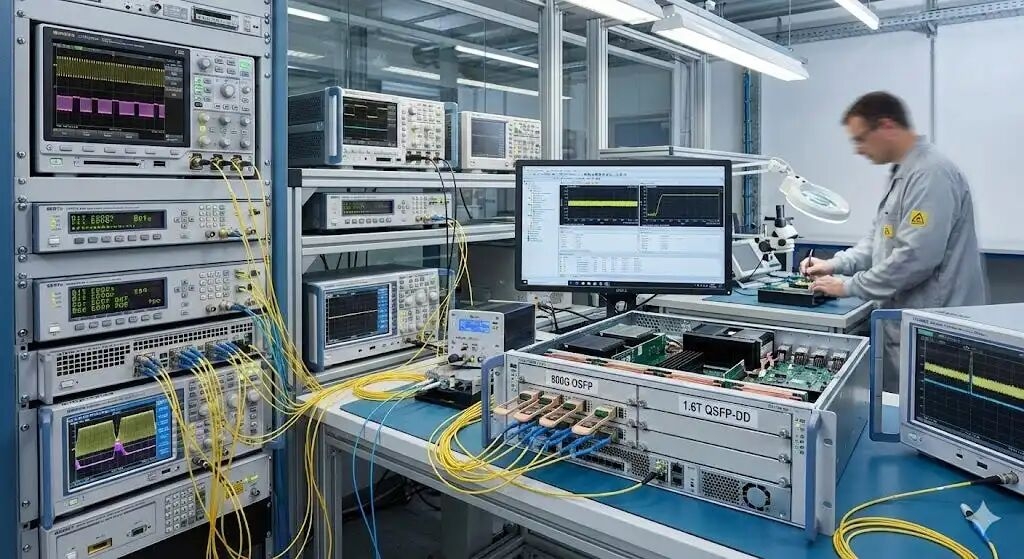
After mass production of finished optical transceivers, a full set of standardized testing procedures must be executed in full compliance with specifications. Every test item and performance parameter must meet defined thresholds to eliminate latent defects and guarantee consistent product quality for commercial shipment. The complete post-production test workflow is detailed as follows:
Transmit optical power is a critical metric that governs the maximum transmission distance and link performance of optical transceivers; both excessive and insufficient output power will degrade link stability. Receiver sensitivity characterizes the minimum detectable optical input power at the receiving end. Generally, transceivers with higher baud rates deliver poorer receiver sensitivity performance.
An eye diagram is formed by superimposing repeated digital signal waveforms captured by an oscilloscope. It provides an intuitive visual assessment for packet loss risk and overall signal integrity. Extinction ratio serves as a key quality indicator for optical transceivers: a higher extinction ratio enhances the distinguishability between logic high/low optical signals and improves receiver sensitivity. Extinction ratio is inversely correlated with transmit optical power — higher extinction ratio corresponds to lower average launch power during testing.
Optical transceivers operate across diverse ambient temperature ranges in field deployments. Prior to factory release, all units must undergo accelerated thermal cycling inside a burn-in chamber. This test verifies whether all electrical and optical performance specifications remain compliant under extreme temperature operating conditions.
Transceivers are plugged into mainstream brand switches matching their form factor for end-to-end connectivity testing. Successful link establishment confirms full hardware interoperability and normal data communication capability. If link-up fails, the unit will be sent for secondary fault diagnosis and rework.
Minor contamination or micro-scratches may form on the fiber ferrule surface throughout the preceding testing stages. Technicians inspect end-face morphology under a fiber microscope. Units passing visual inspection proceed to packaging and delivery; defective end-faces will go through cleaning or rework procedures before re-inspection.