/ From: / Review:6
Switches fall into three hardware-configuration categories: all-copper-port switches, all-optical-port switches, and hybrid switches equipped with both optical and copper ports. Fundamentally, there are only two port types: optical ports and copper ports.
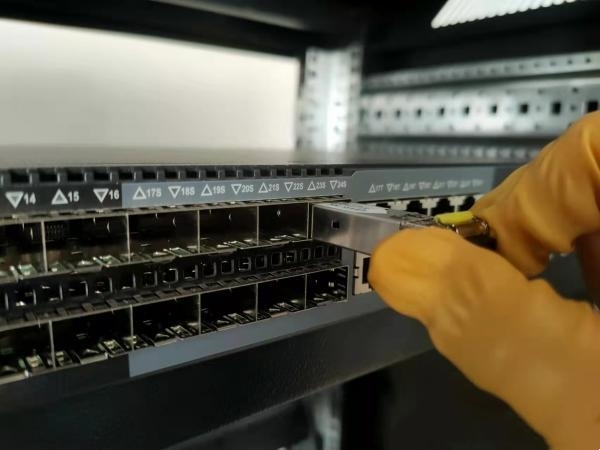
Switch optical ports are designed to accept optical transceivers for data transmission over optical fibers. In scenarios where copper ports are insufficient, users may install copper-port transceivers into optical ports to enable data transmission over copper cables. Widely-supported bit-rates for switch optical ports include 155 M, 1.25 G, 10 G, 25 G, 40 G and 100 G.
A switch copper port integrates a built-in copper transceiver chip, so no additional optical-to-electrical conversion is required. It adopts the RJ45 physical interface, and data transmission is achieved simply by plugging in Ethernet cables. Common rated speeds for copper ports are 10 M/100 M/1000 M and 10 G. For 1000 M and lower-speed links, Category-5 or Category-6 Ethernet cables are sufficient. For 10 G networks, Category-6A or higher-grade cables shall be deployed.
Differences Between Optical Ports and Copper Ports on Switches
1)Transmission Rate
Optical ports can support rates beyond 100 G, whereas the maximum rate for mainstream copper ports is 10 G.
2)Transmission Distance
When paired with appropriate optical transceivers, optical ports can achieve transmission distances exceeding 100 km. By contrast, copper-port links over twisted-pair cables have a maximum reach of approximately 100 meters.
3)Interface Form Factor
Optical ports accept either optical transceivers or copper-port transceivers. Supported connector types include LC, SC, MPO and RJ45 (RJ45 applies only to copper-port transceivers). Native copper ports exclusively use RJ45 connectors.