
/ From: / Review:5
Connectivity is the core foundation of the fiber optical communication industry. This article introduces MPO and MTP fiber assemblies, analyzes their structural distinctions, and provides practical guidance for engineering deployment.
MPO stands for Multi-fiber Push-On. MPO fiber patch cords consist of MPO multi-fiber connectors and optical cables. Adopted by IEEE as the standard connector for 40G and 100G transmission systems, MPO connectors differ fundamentally from single-fiber connectors such as LC, SC and FC in fiber count and ferrule structure, featuring a more intricate mechanical design.
The high-density MPO pre-terminated cabling system is widely deployed in three major scenarios: high-density interconnection inside data centers, Fiber-to-the-Building (FTTB) networks, and internal wiring of optical devices including splitters and optical transceivers.
MTP, short for Multi-fiber Terminal Plug, is a high-performance upgraded variant of standard MPO connectors with proprietary optimized structures. It delivers enhanced mechanical performance and universal compatibility while fully complying with all industry specifications for MPO connectors, allowing direct replacement of conventional MPO connectors to boost overall link performance.
MTP is a patented registered product of US Conec. Standard MPO connectors dominate the mainstream market, while MTP components carry a higher price premium.
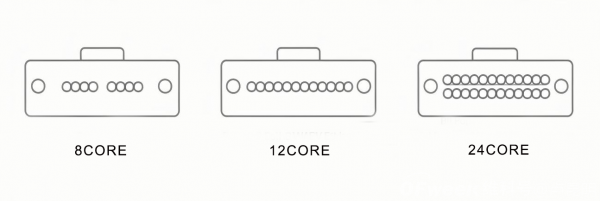
Unlike single-fiber LC, SC and FC connectors, MTP/MPO assemblies support a wide fiber count range from 6 to 144 cores, with 12-fiber and 24-fiber variants being the most widely used in field deployment. Per industry standards, 12-fiber ferrules adopt a single-row layout, whereas 24-fiber and higher-count ferrules utilize multi-row stacking configurations, primarily serving interconnections for 40G and 100G optical modules.
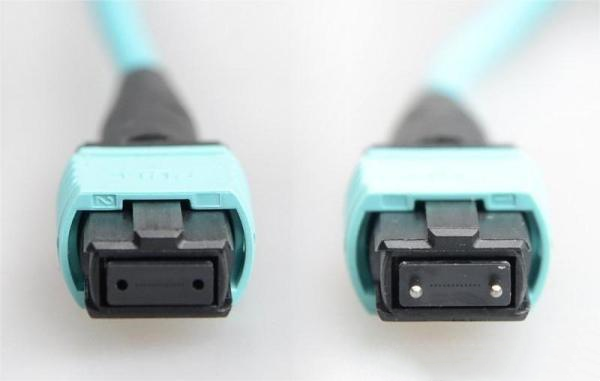
MTP/MPO connectors are categorized into male and female versions. Male connectors are equipped with two alignment pins, while female connectors have empty alignment holes. Pin positioning ensures precise core alignment during mating, and interconnection strictly requires one male and one female connector as a matched pair.
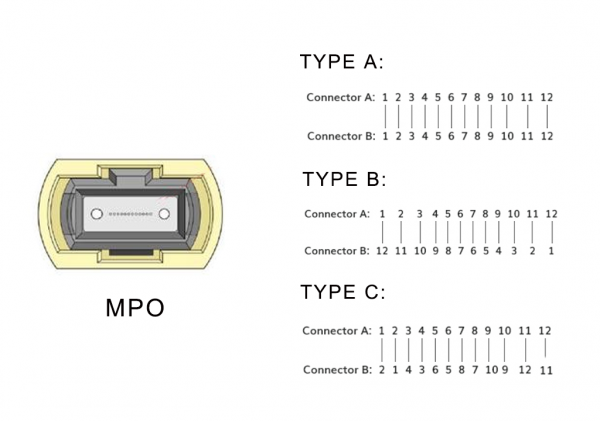
Based on fiber routing sequence, MTP/MPO assemblies are classified into three wiring types: Type A straight-through, Type B reversed, and Type C paired reversed.
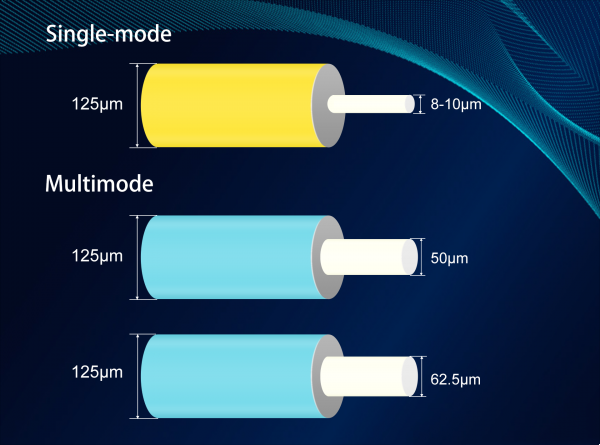
Both single-mode and multi-mode fibers are compatible with MTP/MPO connectors, with fiber type determined by transmission distance and bandwidth requirements of specific applications.
Single-mode MTP/MPO assemblies: Engineered for long-haul transmission. They transmit a single light beam through a solid glass core and support transmission distances up to 100 km.
Multi-mode MTP/MPO assemblies: Designed for short-reach transmission. Multiple light propagation modes enable higher data throughput, yet introduce severe signal attenuation over extended distances. They are mainly applied for intra-building and intra-data center links.
1) Are MTP and MPO connectors interoperable?
Yes. MTP and MPO connectors maintain full physical and functional interoperability.
2) Can MTP and MPO cables be deployed for both single-mode and multi-mode links?
Yes. MTP and MPO cable assemblies feature broad versatility and support both single-mode and multi-mode optical transmission systems.
3) Which type is preferred for high-density cabling infrastructures, MTP or MPO?
MTP connectors are recommended for high-density cabling systems. As an optimized high-performance derivative of MPO, MTP’s structural design is tailored for high port density and superior link performance.
4) What fiber types match MPO/MTP array connectors?
MPO and MTP array connectors are exclusively paired with multi-fiber trunk cables. Their compact ferrule design enables simultaneous termination of multiple optical fibers within a single connector housing.

